


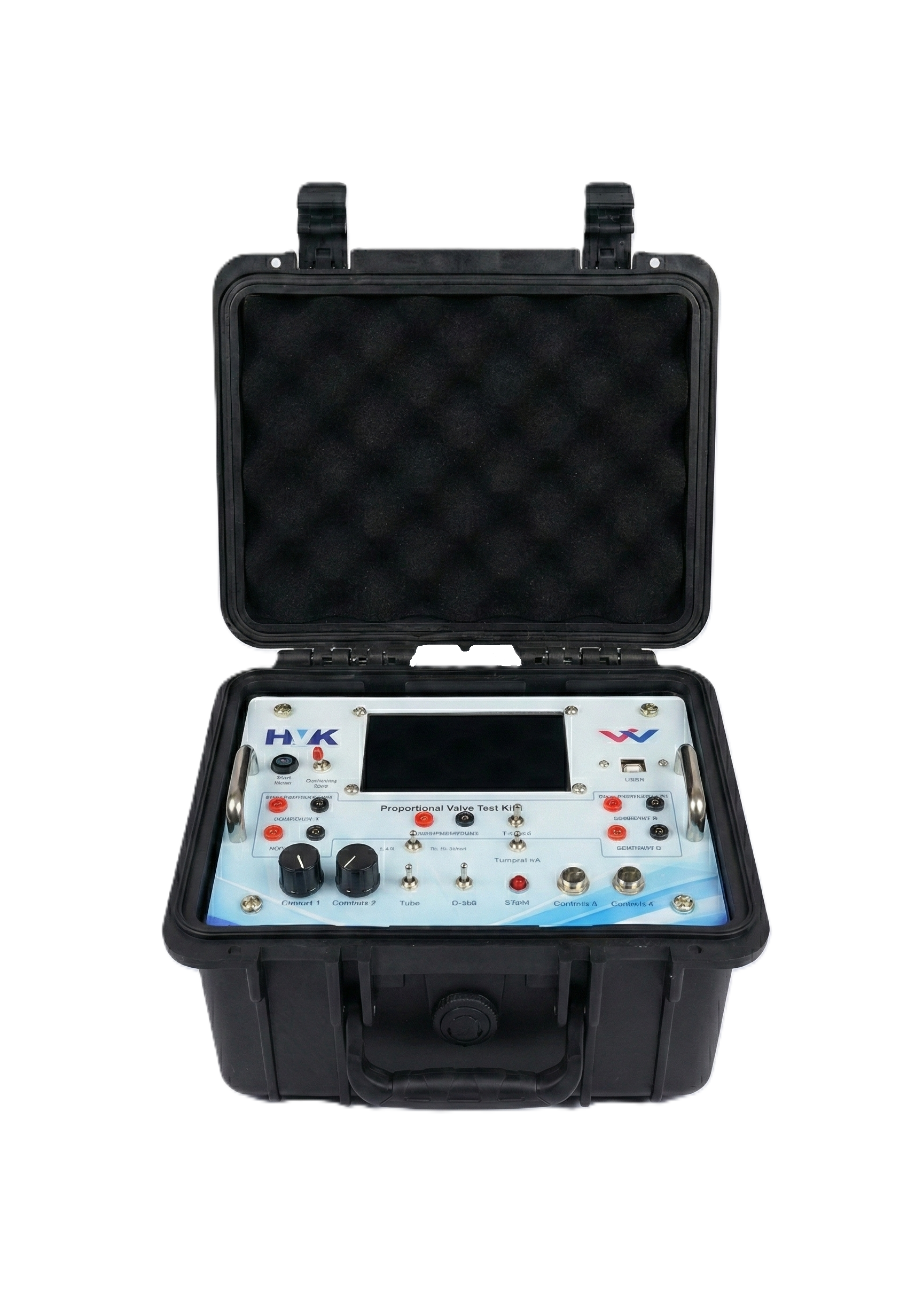
PVC — Proportional Valve Checker
Find out in minutes whether a proportional valve is healthy — on the bench or on the shop floor, without a running hydraulic system.
Valve, card, or PLC?
A machine is drifting, jerking, or not holding position. Three parts could be to blame, and without a way to drive the valve on its own, teams swap parts on guesswork or send the valve out for testing.
The PVC drives the valve directly. If the spool responds smoothly to the PVC, the valve is fine and the fault is upstream. If it doesn’t, you’ve found it.
How it works
Connect
Plug the valve’s solenoids into channel A, channel B, or both, using the 2-pin connectors.
Choose the signal
Select ±10 V, 0–10 V or 4–20 mA — the same type of command the valve gets on the machine.
Command and watch
Turn the knob in 0.1 V steps and read the command, mode and solenoid current on the 4.3″ touch screen.
Which PVC do I need?
It depends on what is built onto your valve. Answer two questions.
1. Does the valve have electronics mounted on it?
2. Does the valve have a spool-position sensor?
Not sure? Send us the valve’s model number and we’ll tell you which PVC fits.
PVC Non-OBE, without feedback
For valves with no electronics on the valve, driven by an external amplifier card.
PVC Non-OBE, with feedback
For valves without on-board electronics that carry a spool-position sensor.
PVC OBE
For valves with electronics built onto the valve (On-Board Electronics).
Where teams use it
- Troubleshooting Isolate a faulty valve on the machine.
- Bench testing Check valves returned from service or repair.
- Field checks Carry it to site — no power unit needed.
- Commissioning Confirm each valve before first start-up.
- Preventive maintenance Catch a sticking spool before it stops production.
- Training Show trainees how proportional valves respond.
Key specifications
| Supply | 24 V DC, 5 A max input |
|---|---|
| Output | 2.6 A max per solenoid, integrated PAM-199-P amplifier |
| Channels | 2 independent (A and B), 2-pin solenoid connectors |
| Command signals | ±10 V, 0–10 V, 4–20 mA |
| Adjustment | Multiturn potentiometer, 0.1 V steps |
| Display | 4.3″ capacitive touch screen |
| Test points | Input voltage, 24 V supply, solenoid current (for a multimeter) |
| Setup | Parameters set with WPC software |
| Works with | Any brand of non-OBE proportional valve within its voltage and current limits |
| Size and weight | Carry case 270 × 231 × 180 mm, about 2.5 kg |
See it in 60 seconds
Common questions
Do I need hydraulic pressure to test a valve?
No. The PVC drives the solenoids electrically, so you can check the valve on a bench without a power unit.
Which valve brands does it work with?
Any brand, as long as the valve is within the PVC’s voltage range and 2.6 A solenoid current limit.
Can I take it on site?
Yes. It weighs about 2.5 kg and comes in a rugged carry case.
Can settings be saved and repeated?
Yes. Parameters and solenoid current are set with WPC software, so the same setup can be reused.
Can I see it working on my own valves?
Yes. Book a demo and an HVK engineer will bring the PVC to your plant.